For years, VMware Cloud Foundation (VCF) was often perceived as “vSphere + vSAN + NSX sold together”. After Broadcom, that interpretation is no longer accurate. VCF has effectively become the control plane for VMware-based private cloud, not just a licensing construct.
The most important change is not technical at first glance – it’s architectural intent. VMware no longer optimizes for infinite design freedom. Instead, it optimizes for repeatability, lifecycle safety, and platform consistency.
From Product Stack to Platform Architecture
Pre-Broadcom, many customers deployed:
- vSphere manually
- NSX optionally
- vSAN selectively
- Each component upgraded on its own timeline
VCF enforces a different model:
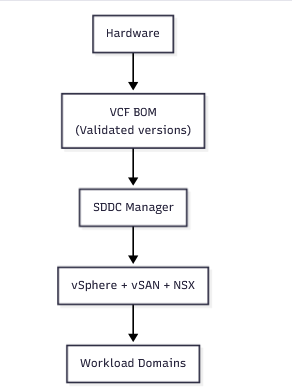
Here, SDDC Manager becomes the real product. vSphere, NSX, and vSAN are no longer first-class citizens on their own – they are managed components inside a platform lifecycle. This is a subtle but fundamental shift.
VCF introduces strict lifecycle coupling:
- You don’t upgrade ESXi alone
- You don’t upgrade NSX independently
- You upgrade the platform as a unit
In VCF, workload domains replace clusters as the primary design unit.
Each workload domain has:
- Its own vCenter
- Its own lifecycle
- Clear separation from other domains
This enables:
- Isolation between production, DMZ, and platform services
- Independent scaling and upgrades
- Reduced blast radius
But it also means:
- More vCenters
- More planning upfront
- Higher operational discipline
VCF is no longer “optional VMware”. It is VMware’s reference architecture made enforceable. If you accept its constraints, you gain stability, lifecycle safety, and a clean operational model. If you resist those constraints, VCF will feel restrictive and heavy.
The key question is no longer “Do we want VCF?”
It’s “Are we willing to operate a standardized platform instead of a handcrafted environment?”