Let me be honest with you. When most people hear “AI agent” they picture something from a sci-fi movie – robots making decisions, autonomous systems running wild. The reality is far more grounded, far more useful, and honestly more exciting because it’s real and available today.
I’ve been working across cloud platforms for years, building everything from enterprise landing zones to full-stack AI platforms. And in the last 12 months, AI agents have become one of the most transformative concepts I’ve seen land in production environments. So let me break this down the way I would in a classroom – clear, practical, no fluff.
So what exactly is an AI Agent?
An AI agent is a software system that combines three things:
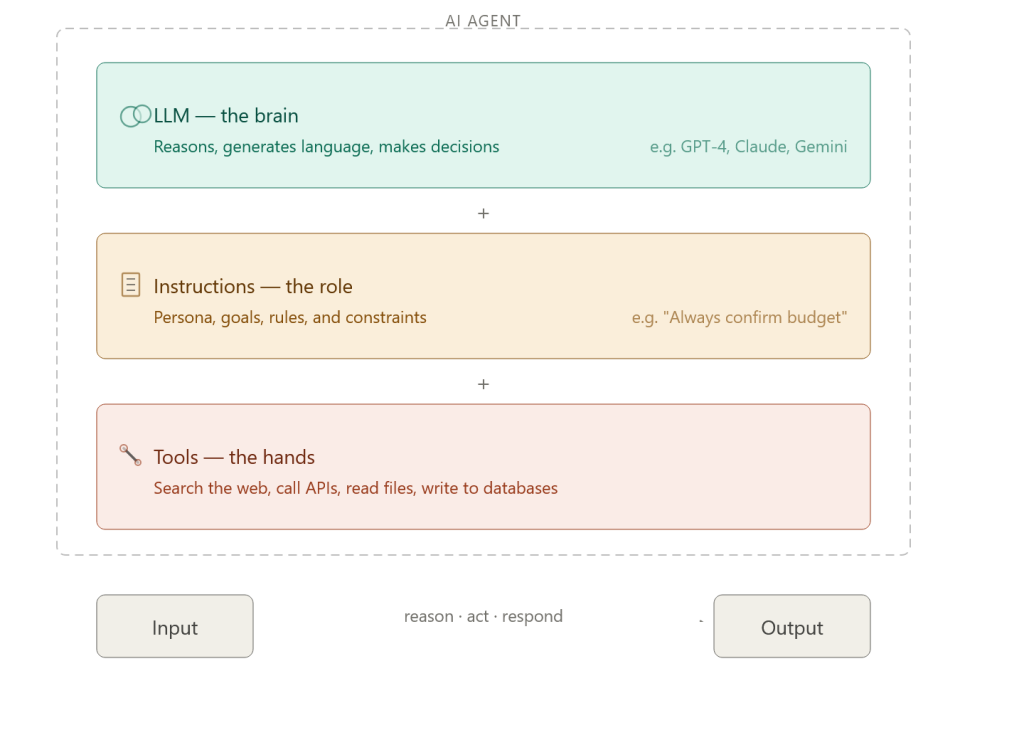
Think of it this way. The LLM (Large Language Model – could be GPT-4, Claude, Llama, Mistral) is the reasoning engine. It’s smart, but on its own it just generates text. The instructions give it a role – like “you are a travel booking assistant, always confirm budget before booking”. The tools give it hands – it can search the web, read files, call APIs, write to databases.
Together, these three things create something that can reason, act, and respond – not just chat.
A Real Example (not a demo toy )
Here’s a scenario I often use in training because it clicks immediately:
User says: “Find leads in the Pacific Northwest retail sector.”
Without an agent: You get a bunch of suggestions on how to find leads. You go do the work yourself.
With an agent:
- The agent searches LinkedIn, CRM systems, and company databases
- Returns 14 qualified leads
- Drafts personalized outreach emails for each one
- Flags 3 as high-priority based on company size and engagement signals
- Books follow-up calls in your calendar for Tuesday and Thursday
That’s not magic. That’s a well-configured agent with the right tools and the right instructions. The LLM is doing the reasoning – deciding which tools to use, in what order, and how to interpret the results.
The Four Pillars of Agent Value
When I talk to clients about why agents matter, I break it down into four concrete business outcomes:
| Benefit | What It Means in Practice |
| Enhanced decision-making | Analyses data across multiple sources to surface insights in real time |
| 24/7 availability | No lunch breaks, no sick days – operates continuously |
| Automation of routine tasks | Handles repetitive work so your team focuses on strategy |
| Scalability | Grows capability without headcount |
That last one is the conversation-stopper in boardrooms. You can scale agent workloads without proportional cost increases. That’s a fundamentally different economics model than traditional software teams.
The AI Workload Landscape
Agents don’t exist in isolation. Here’s how they fit into the broader AI landscape:
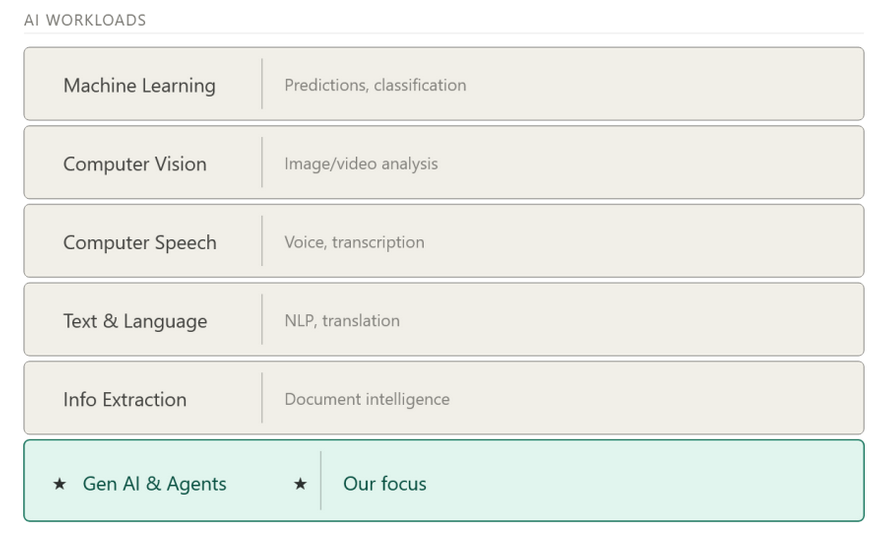
Generative AI and Agents sit at the top of the stack because they orchestrate the others. An agent can call a vision model to analyse an image, then use NLP to summarise findings, then take an action in an external system – all in one workflow.
Pros and Cons – Let’s Be Honest
Pros:
- Dramatically reduces time-to-action for knowledge workers
- Can work across systems that don’t natively integrate
- Improves consistency – same instructions, same behaviour every time
- Easy to iterate on (change the instructions, not the code)
Cons:
- Poorly configured agents make confident mistakes (hallucination risk is real)
- Security boundaries need careful design – an agent with too many tools is a risk
- Debugging is harder than traditional code – reasoning steps aren’t always transparent
- Cost management matters – every LLM call has a price tag
The Mental Model That Changes Everything
Here’s what I tell everyone when they first encounter agents: stop thinking about software as a set of if/else statements and start thinking about it as a team of specialists you can delegate to.
You don’t write code to tell a colleague exactly how to do their job. You give them context, expectations, and access to the tools they need. Then you let them work.
That’s exactly how agents work. And once that clicks, everything else falls into place.
What’s Next?
In the next article, I’ll walk through how to actually build one of these agents using Microsoft Azure AI Foundry – the infrastructure layer that handles state management, tool orchestration, and deployment so you don’t have to reinvent that wheel yourself.
If this was useful, share it with someone who keeps asking “but what is an AI agent?” – you’ll save yourself a 20-minute conversation.